
There is something deeply satisfying about looking around your home and knowing that the beautiful things decorating it were made by your own hands. DIY home decor projects give you that feeling — and they deliver so much more besides. They save money, they let you customize every detail to perfectly suit your space, and they bring a warmth and authenticity to your home that no store-bought piece can truly replicate.
The best part? You don’t need to be a skilled craftsperson, spend a fortune on supplies, or dedicate weeks of your time to create something genuinely beautiful. The DIY home decor projects in this guide are all achievable in a single weekend — many in just a few hours — using tools and materials that are easy to find and affordable to buy.
Whether you’re a complete beginner looking for your first project or an experienced maker ready for your next creative challenge, there’s something here for every skill level, every room, and every style. Let’s get started.
Why DIY Home Decor Projects Are Worth Your Time
Before we jump into the projects themselves, let’s talk about why DIY home decor is genuinely worth investing your weekend in.
First, there’s the cost. Professional decor items — especially anything handmade, artisan, or designer — can be extraordinarily expensive. Many of the most beautiful and on-trend pieces you see in home decor stores can be recreated at home for a fraction of the retail price, using the same or equivalent materials.
Second, there’s the customization. When you make something yourself, you choose every detail. The exact color, the precise size, the specific finish — everything is tailored to your space and your taste in a way that off-the-shelf products simply cannot match.
Third — and perhaps most importantly — there’s the joy of it. Making things with your hands is one of the most reliably satisfying human experiences. It’s creative, it’s meditative, and the sense of accomplishment when a project comes together is genuinely wonderful.
With that said, let’s explore the best DIY home decor projects you can complete this very weekend.
Project 1 — Create a Stunning DIY Gallery Wall
Difficulty: Beginner Time Required: 3 to 5 hours What You Need: Frames, artwork or prints, hammer, nails, level, measuring tape, paper, pencil
A gallery wall is one of the most impactful DIY home decor projects you can undertake, and it requires absolutely no specialist skills whatsoever. A well-executed gallery wall transforms a plain, empty wall into a personal, curated focal point that makes the whole room feel more intentional and alive.
Here’s how to plan and execute yours:
- Choose a wall and decide on your overall shape — a grid arrangement for a clean, modern look, or a loose, organic arrangement for a more eclectic, boho feel.
- Gather your frames. Mix different sizes for visual interest, but keep the finish consistent — all black, all natural wood, all gold — for a cohesive result.
- Choose your artwork. This can be anything — printed photographs, downloaded art prints, pages torn from art books, children’s drawings, pressed botanicals, or abstract painted pieces you create yourself.
- Lay everything out on the floor first to plan your arrangement before touching the walls.
- Cut paper templates the size of each frame, tape them to the wall in your chosen arrangement, and adjust until you’re happy.
- Nail through the paper templates to place your hooks perfectly, then tear the paper away and hang your frames.
The result is a gallery wall that looks completely intentional and professionally arranged — because it was, just not by a professional.
Project 2 — Make Your Own Macrame Wall Hanging
Difficulty: Beginner to Intermediate Time Required: 4 to 6 hours What You Need: Macrame cotton rope, a wooden dowel or driftwood, scissors, a comb
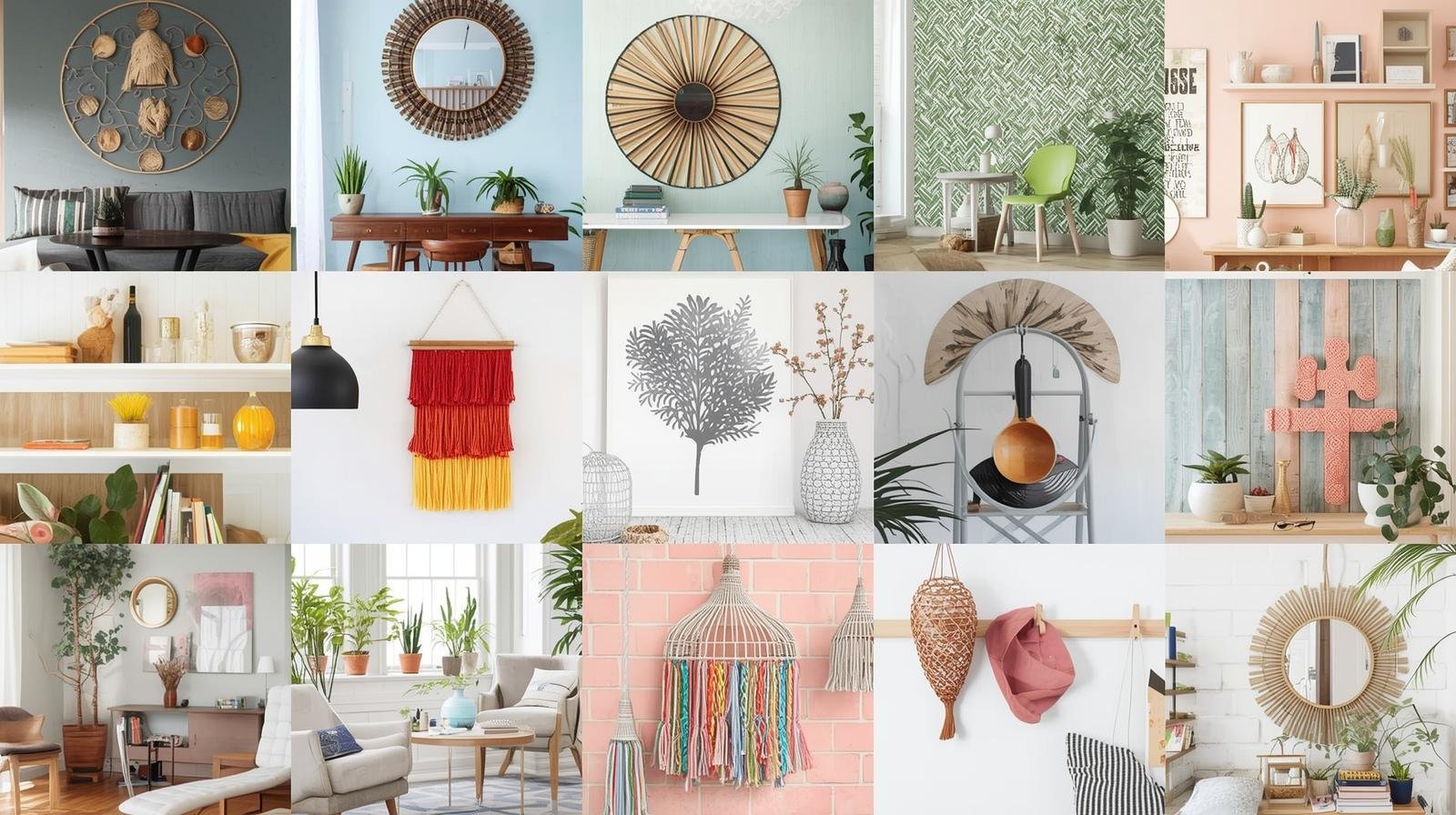
Macrame is one of the biggest DIY home decor trends of recent years, and for excellent reason — the finished pieces look stunning, the technique is surprisingly accessible, and the meditative rhythm of the knotting process is genuinely enjoyable.
A basic macrame wall hanging uses just two or three simple knot types. Here’s what you need to know to get started:
- The square knot and the spiral half-square knot are the two most fundamental macrame techniques. Both can be learned within thirty minutes from a simple online tutorial.
- Cut your rope lengths to approximately four times the desired finished length of your piece, as the knotting process consumes considerable length.
- Fold each rope in half and attach it to your dowel using a larks head knot — this is as simple as it sounds and takes about five seconds per cord.
- Work your way across the piece using square knots, varying the spacing and grouping to create different patterns and textures.
- Finish with a fringe at the bottom, combing out the rope ends with a wide-toothed comb for a soft, feathery effect.
Your first macrame wall hanging will take longer than future ones, but even a beginner’s first attempt typically produces something beautiful enough to hang proudly. This is one of those DIY home decor projects that genuinely looks far more difficult than it is.
Project 3 — Build a Simple Floating Shelf
Difficulty: Beginner Time Required: 2 to 4 hours What You Need: Wooden plank, shelf brackets, screws, drill, wall plugs, level, sandpaper, paint or wood stain
Floating shelves are endlessly useful and thoroughly on-trend, and building your own is far simpler than most people expect. A basic floating shelf requires only the most elementary woodworking skills — if you can drill a straight hole and use a spirit level, you can build a beautiful shelf.
Here’s a simple approach for a beginner-friendly floating shelf:
- Choose your wood. A planed pine plank is the most affordable option. Solid oak looks more premium and works beautifully with warm, natural interiors.
- Sand the wood smooth, starting with a medium-grit paper and finishing with a fine-grit for a silky surface.
- Finish with paint in your chosen color or a natural wood stain sealed with a clear varnish. Both options look fantastic, depending on your interior style.
- Choose your brackets — visible industrial-style brackets look modern and cool, while hidden internal brackets create a true floating effect.
- Use a spirit level to mark your bracket positions, drill into the wall, insert your wall plugs, and secure the brackets with screws.
- Attach your shelf plank to the brackets and check its level before styling it with books, plants, and decorative objects.
Making your own floating shelf means you get exactly the length, depth, color, and style you want — and you save a significant amount compared to buying one ready-made.
Project 4 — Paint a Bold Accent Wall
Difficulty: Beginner Time Required: One full day, including drying time What You Need: Paint, primer, roller, brush, painter’s tape, drop cloth, tray
An accent wall is one of the fastest and most transformative DIY home decor projects available — and in 2026, bold, confident accent wall colors are very much on trend.
Deep forest green, rich terracotta, warm navy, and moody burgundy are all magnificent choices for a statement wall. Here’s how to paint one perfectly:
- Choose your wall carefully — typically the wall your eye is drawn to first when you enter the room, or the wall your bed or sofa sits against.
- Clean the wall thoroughly and fill any holes or cracks with filler. Allow it to dry and sand smooth.
- Apply painter’s tape around edges, the ceiling line, and any adjacent walls where you want a clean finish.
- If your chosen color is very dark or very different from your existing wall color, apply a coat of primer first to ensure even coverage.
- Paint using a roller for the main surface and a brush for cutting in around edges. Apply two coats for the richest, most even result, allowing full drying time between coats.
- Remove the painter’s tape while the final coat is still slightly damp for the cleanest possible edge.
The transformation that a single painted wall creates is remarkable. It’s one of those DIY home decor projects where the result genuinely exceeds expectations every single time.
Project 5 — Create Handmade Concrete Planters
Difficulty: Beginner to Intermediate Time Required: Weekend project — Saturday to make, Sunday to style What You Need: Concrete mix, water, two containers of different sizes (plastic bowls, cardboard boxes, yogurt pots), cooking oil spray, sandpaper, gloves, dust mask
Concrete planters are one of the hottest home decor items right now — and they’re remarkably simple to make yourself. A store-bought concrete planter can cost a surprisingly large amount. Handmade ones cost almost nothing and look just as beautiful.
Here’s the basic process:
- Choose your mold containers. A large outer container and a smaller inner container will create the planter shape. Cardboard, plastic, and polystyrene all work well.
- Mix your concrete according to the package instructions until it reaches a thick, smooth consistency.
- Spray the inside of your outer mold and the outside of your inner mold with cooking oil to prevent sticking.
- Pour concrete into the outer mold to a depth of about 2 to 3 centimeters. Place the inner mold on top and press down to your desired depth.
- Allow to cure for at least 24 to 48 hours before carefully removing the molds.
- Sand any rough edges smooth and allow the concrete to fully cure for another day before adding plants.
Style your finished planters with succulents, trailing plants, or small cacti in terracotta-toned soil for a look that feels contemporary, earthy, and genuinely artisan.
Project 6 — Upcycle Old Furniture with Paint and New Hardware
Difficulty: Beginner Time Required: One to two days, including drying time What You Need: Chalk paint or furniture paint, primer, sandpaper, new hardware, screwdriver, paintbrush, clear wax or varnish
One of the most rewarding and sustainable DIY home decor projects you can take on is transforming a tired, old piece of furniture into something that looks completely new, fresh, and design-forward.
A second-hand chest of drawers, a dated bedside table, a worn dining chair, or an old coffee table can all be completely transformed with a coat of paint and some new hardware. Here’s how to do it beautifully:
- Start by cleaning your furniture piece thoroughly. Remove any dirt, grease, or polish residue.
- Sand lightly to create a surface the paint can adhere to. For furniture with a shiny finish, sand more thoroughly.
- Apply a primer if you’re making a dramatic color change. Allow to dry completely.
- Apply your chosen furniture paint in thin, even coats — typically two to three coats give the best result. Chalk paint is especially forgiving for beginners and requires minimal prep.
- Once fully dry, add a finishing coat of clear furniture wax or varnish for durability and a beautiful sheen.
- Replace the existing hardware with new handles or knobs in a finish that suits your interior — brushed brass, matte black, and ceramic knobs are all incredibly popular choices right now.
The combination of a fresh paint color and updated hardware is genuinely transformative. What looked like a piece ready for the skip becomes something that looks custom-made and thoroughly modern.
Project 7 — Make a Beautiful Dried Flower Arrangement
Difficulty: Beginner Time Required: 1 to 2 hours (plus drying time for flowers) What You Need: Dried flowers and grasses, a vase or vessel, floral wire or twine, scissors
Dried flower arrangements are one of the biggest and most enduring home decor trends of recent years, and making your own is one of the simplest and most affordable DIY home decor projects on this entire list.
Unlike fresh flowers, dried arrangements last for months or even years with virtually no maintenance — no water, no wilting, no weekly replacements.
The most beautiful and trending dried botanicals to work with right now include:
- Pampas grass for soft, feathery volume and a neutral, warm tone
- Dried lavender for color, fragrance, and a timeless, romantic quality
- Eucalyptus stems for their silvery-green texture and a beautifully clean scent
- Bunny tail grass for playful, delicate movement
- Dried orange slices for warmth and a touch of unexpected color
- Dried cotton stems for a sculptural, organic quality
To create your arrangement, simply gather your stems into a loose bunch, adjust until you’re happy with the composition, and place them in a vessel that suits your interior — a ceramic vase, a glass bottle, a terracotta pot, or even a woven basket all work beautifully.
Hang bundles of lavender or eucalyptus upside down to dry your own botanicals at home — the drying process itself becomes a decorative feature.
Project 8 — Create a DIY Woven Wall Basket Gallery
Difficulty: Beginner Time Required: 2 to 3 hours What You Need: Assorted woven baskets in different sizes and shapes, picture hanging strips or small nails, hammer
A woven basket wall gallery is one of the most stylish and accessible DIY home decor projects you can tackle this weekend. It requires no crafting skills whatsoever — just an eye for arrangement and the confidence to commit to putting baskets on your wall.
Here’s how to create yours:
- Collect an assortment of woven baskets in different sizes, shapes, and weave styles. Look for a mix of round, oval, and irregular shapes. Rattan, seagrass, jute, and bamboo all work beautifully together.
- Lay them on the floor and experiment with arrangements until you find one that feels balanced and pleasing.
- Hang using picture hanging strips for a damage-free option, or small nails for a more permanent installation.
- Mix in one or two flat woven plates or a macrame piece to add variety to the arrangement.
A woven basket wall looks stunning in a living room, bedroom, or hallway. It adds extraordinary texture and warmth to a plain wall at very low cost — especially if you source your baskets from thrift stores or discount homeware shops.
Weekend Project Planning — Tips for DIY Success
Before you launch into your chosen DIY home decor projects, a few practical tips will help ensure everything goes smoothly:
- Plan before you buy. Measure your space, sketch your idea, and make a complete materials list before purchasing anything. This prevents the frustration of mid-project supply runs.
- Start simple if you’re a beginner. The gallery wall, dried flower arrangement, and basket wall are all brilliant starting points that deliver beautiful results with very low risk.
- Invest in good-quality tools. A reliable drill, a good level, and quality paintbrushes will make every project significantly easier and more enjoyable. These are tools you’ll use again and again.
- Work in good light. Whether you’re painting, knotting, or arranging, adequate lighting makes every task easier and helps you spot any issues before they become problems.
- Embrace imperfection. Handmade things are beautiful precisely because they’re not machine-perfect. The slight irregularities in your macrame, the small brush strokes in your painted furniture — these are features, not flaws.
- Take your time. Most beginner mistakes come from rushing. Allow paint to dry fully between coats. Let the concrete cure completely before demolding. Good results reward patience.
Conclusion — Your Most Beautiful Home Starts This Weekend
The best time to start transforming your home is right now — this weekend. You don’t need a big budget, professional skills, or weeks of preparation. You need a project that excites you, a few basic materials, and the willingness to make something with your own hands.
DIY home decor projects give you something that no shopping trip ever can: the deep, lasting satisfaction of a home you’ve genuinely built yourself. Every time a guest admires your gallery wall, your macrame piece, or your painted dresser and asks where it came from, you get to say the most satisfying words in all of home decorating: I made it myself.
Choose one project from this list — just one — and commit to completing it this weekend. Start small if you need to. Build confidence with a dried flower arrangement or a basket wall, then graduate to painting furniture, building shelves, or learning macrame.
Your home deserves to be as beautiful, personal, and creative as you are. Pick up your tools, clear the dining table, and get making. The most rewarding version of your home is just one weekend away.
Frequently Asked Questions (FAQs)
H3: 1. What are the easiest DIY home decor projects for beginners? The easiest DIY home decor projects for beginners include creating a gallery wall, making a dried flower or botanical arrangement, hanging a woven basket wall display, and painting an accent wall. These projects require no specialist tools or skills, can be completed in a few hours, and consistently deliver beautiful, professional-looking results even on a first attempt.
2. How much do DIY home decor projects typically cost? The cost varies depending on the project, but most weekend DIY home decor projects can be completed for between ten and fifty dollars in materials. Projects like gallery walls and dried arrangements can be done for almost nothing if you use printed artwork and foraged or home-dried botanicals. Furniture painting requires more materials but still costs a fraction of what a comparable new piece would retail for.
3. Do I need special tools for DIY home decor projects? Most of the projects in this guide require only basic household tools — a hammer, a level, scissors, and a drill for wall-based projects. A good quality drill is the single most useful tool investment for home decor DIY, as it’s needed for shelves, gallery walls, and hardware replacement. Craft-based projects like macrame and dried arrangements require no tools at all beyond scissors.
4. How do I choose which DIY home decor project to start with? Choose based on your current skill level, available time, and the room that most needs a refresh. If you’re a complete beginner, start with a project that requires no construction or crafting skills — a gallery wall arrangement or a dried botanical display. If you’re comfortable with basic tools, a floating shelf or furniture upcycle project will deliver an impressive transformation. Always match your first project to a realistic assessment of your current confidence and skills.
5. Can DIY home decor projects really look as good as store-bought items? Absolutely — and in many cases, handmade DIY pieces look significantly better than mass-produced store alternatives because they’re custom-sized, personally styled, and carry the warmth of something genuinely handcrafted. Macrame wall hangings, concrete planters, painted furniture, and gallery walls made at home routinely look more beautiful and more personal than their store-bought equivalents. The key is taking your time, following good preparation steps, and embracing the natural beauty of handmade imperfection.

Leave a Reply